Saturday, September 09, 2006

Book meme

What better than a meme to get back into blogging? Thanks to Sophia for the tag!

1. One book that changed your life: As anticlimactic as this might be for a start to a meme, I have no answer to this. There is no book that changed my life. Perhaps I am too young. But, as Pan said, a book that changed your life may be a book that made you think thoughts you'd never thought before. In that case, I'd say The Little Prince, by Antoine de Saint-Exupéry. It's a book that everyone should read. It should be made a compulsory read for all schoolchildren. One day, when I become the ruler of the universe, I shall make sure that everyone reads it.

2. One book that you’ve read more than once: The His Dark Materials trilogy by Philip Pullman. Can't wait for the movie to be released. Especially as it's got Eva Green and Nicole Kidman. I'm pretty miffed that Daniel Craig and not Jason Isaacs is playing Lord Asriel, because Jason Isaacs is just... well, I don't think words could do him justice.

3. One book you’d want on a desert island: The entire Harry Potter series, after book seven comes out, obviously, because I really wouldn't want to be tormented with thoughts on whether Snape is truly evil or not, or what the last Horcrux is, or if Ron and Hermione will finally DO IT. Not when I'm on a desert island getting bitten by mosquitos.

4. One book that made you laugh: The Hitchiker's Guide to the Galaxy, the entire series, by Douglas Adams. I found the plots rather weak, overall, but the silly chapters, the Guide entries, Random's teenage drama, everything, it was all hilarious. I've never snickered so much in my life as I did whilst reading those books. Even on a 16-hour bus ride from Antalya to Sivas, when everyone else was sleeping and getting mad at me for keeping my lights on.

5. One book that made you cry: Swann's Way, by Marcel Proust. Well, I had tears building up at any rate, and all because of the beauty of that book. It wasn't the plot, it wasn't anything, it was just that it's such a beautiful, beautiful book, and beauty can be so moving. Sigh. I wish I could read it again like it was the frist time.

6. One book that you wish had been written: My wife, TPF, by Thomas Hardy. I LOVE YOU, THOMAS! COME BACK AND MARRY ME!

7. One book that you wish had never been written: Great Expectations, because it is dull. And Hardy is so much better! SO THERE!

8. One book you’re currently reading: Latife Hanım, by Ipek Çalışlar, about Mustafa Kemal Atatürk's wife. It's in Turkish, and I'm not used to reading in Turkish, so it's a bit of a challenge, but being a shameless history nerd, I enjoy these kinds of books.

9. One book you’ve been meaning to read: The Simoqin Prophecies, by Samit Basu.

10. Now tag six people, which I shall be unable to do because anyone I could tag has already been tagged. Sigh.

Labels: ,

Saturday, April 15, 2006

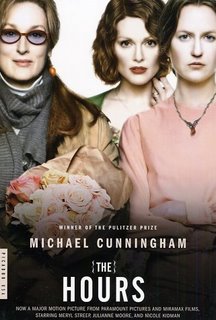
The Hours

I finished reading The Hours the other day instead of some much-needed studying. I didn't like it.


The movie adaptation of the novel is one of my all-time favourite films. I've seen it four or five times, which is a lot considering that The Hours is neither Mean Girls nor Ghostbusters, meaning that it's hardly the material for amusement. So yes, I really loved the movie, which is why I decided to read the book. Besides, I thought, it won the Pulitzer; it must be good, right? Right?

Wrong.

If I'm picking up a book that won a prize, I'm expecting something other than a good plot and deep philosophical reflection, thank you very much. The movie had all that in anyway. What I'm expecting from the book is style, well-crafted language, interesting parallels, inventive metaphors and imagery. I'm not necessarily looking for avant-garde literary experimentation (which I happen to dislike), but a semblance of competence would go a long way.

And what do I get? 226 pages of present tense. I mean, seriously, Mr. Cunningham, there's a reason if 99% of the world's novels are written using some form of the past tense! There's a whole bloody tense invented solely for use in storytelling (well, there is in French and Italian)! USE IT!

But noooo, you have to do your best to irritate me in all possible ways, just because the present tense is effective.

Newsflash, berk, it's only effective for ONE PAGE. Or two, if you really must.

Oh, and since the only way to win prizes is to do something unusual, you go and make every single character gay, or at the very least bisexual. Which is perfectly fine when Virginia Woolf does it, because guess what? SHE CAN WRITE.

And of course, your pressing need to be cool and original, because that's what the in crowd does nowadays, comes to the fore in some rather interesting decriptive passages which do nothing for the reader (me) but incense her further. Because you thought it might be amusing to write stuff that DOESN'T MAKE SENSE.

Example: 'Laura is at once comforted and unnerved.'

Now, I understand that you desperately want to win the Pulitzer, but there's something called common sense. You simply cannot be both comforted and unnerved at the same time. The two terms are, by definition, mutually exclusive. It's not like being happy and sad at the same time, or, taking non-literal meanings into account, clean and dirty. No, this is like suggesting that it might be possible to be calm and nervous, or lost and found, all at the same time.

IT'S IMPOSSIBLE!

I don't know, were you going for effect? It just made me laugh. And the worst part is, the rest of the novel is that kind of thing over and over and over again. In the present tense.

You know what I'm going to do? I'm going to write a one-paragraph 'novel' and get it published and win the Pulitzer. You, my dearest readers, are getting a sneak preview. You have no idea how lucky you are to be given this once-in-a-lifetime opportuniy. Here goes:

TPF walks out of her trendy loft in New York City [because all cool novels are set in New York, didn't you know? You try setting one in Stratford-Upon-Avon, see how many Pulitzers that gets you!] and goes to buy flowers just like Mrs. Dalloway did in that old book, and it's a great idea to have three parallel stories going on like that, I like the idea. Suddenly, TPF notices a beautiful Golden Retriever walking ahead and feels an immediate attraction towards it because if she wants to win the Pulitzer, she must be attracted to dogs as well as men, women, children and priests. So TPF follows the dog and thinks of her life, here in NYC, and decides that it's definitely worth living. She decides to buy a hot dog, because dogs are HOT. She bites it and realizes that it's both hot and cold (don't ask, she has weird nerve endings). She walks back home briskly, yet at the same time slowly, and decides that she loves life. But she hates it, too.

Well, I'm not quite happy with that first draft, I'll have to tweak it a bit, but what do you think? Do I have a chance?


OK, I'll stop being mean now. With that spirit, I shall conclude this post by being nice about Veronica Mars, that weird TV show they've started airing in Italy with the main character who is anything but conventional. I mean, she got drugged and raped at a party! It's risky. I like it.

PS: More about Mr. Cunningham? Read this interview. It's quite interesting, actually.

Labels: ,

Tuesday, January 31, 2006

The word is as powerful as the sword...

Sometimes, literature can make you stop and stare at the page, a 'whoosh' of excitement filling your ears, thrill and goosebumps all over the place, a sudden inability to breathe, and the words 'Oh. My. God.' running through your head. Repeatedly.

Ever had that feeling? I have. Multiple times.


When this occurs, the cause is mostly to do with plot. It is either an incredible twist, or something that suddenly alters the tone of the work, something that makes you think 'things will never be the same again', or an idea that is so amazing that you remain shell-shocked, and need a few deep breaths to get back to normal.

And now, a few example of scenes that cause me to react exactly this way. Please skip what you haven't read if you don't want to be spoiled.


I want to start with a passage from the last chapter of The Subtle Knife, the second book in the His Dark Materials trilogy by Philip Pullman. Mrs. Coulter is, to put it mildly, interrogating the witch Lena Feldt as to the the whereabouts of her daughter Lyra. Here's the passage:

'"And now tell me this. You witches know something about the child Lyra. I nearly learned it from one of your sisters, but she died before I could complete the torture. Well, there is no one to save you now. Tell me the truth about my daughter."
Lena Feldt gasped: "She will be the mother - she will be life - mother - she will disobey - she will -"
"Name her! You are saying everything but the most important thing! Name her!" cried Mrs. Coulter.
"Eve! Mother of all! Eve, again! Mother Eve!" stammered Lena Feldt, sobbing.
"Ah," said Mrs. Coulter.
And she breathed a great sigh, as if the purpose of her life was clear to her at last.'

I remember reading that page three more times, open-mouthed. The concept of Lyra as Eve, the importance of naming her, Mrs. Coulter sighing... Masterful.


The next scene is from Thomas Hardy's Tess of the D'Urbervilles. I will spare you the fangirl's gushing over Hardy; my friends are the usual audience to that. But please allow me to rave over this particular scene: it is chapter 56, from 'Fulfilment', and the householder Mrs. Brooks observes a red stain on the ceiling getting gradually larger. It's blood, as she soon understands. As we understand, Tess has murdered Alec Stoke-D'Urberville. He appears to be bleeding on the carpet. Chilling.


In Orwell's Nineteen Eighty-Four, all semblance of security is snatched away in one little line. Winston and Julia are lying in bed, after having had sex for the umpteenth time (go them! At least they get some). Winston is brooding about how there might yet be hope for the future generations. 'You were the dead; theirs was the future,' he thinks. Poor Winston!

'"We are the dead," he said.
"We are the dead," echoed Julia dutifully.
"You are the dead," said an iron voice behind them.

Oops. Busted. And, oh, shit.


Wimpy, whinging Jonathan Harker witnesses this scene in Count Dracula's castle.

'[...] I saw the whole man slowly emerge from the window and begin to crawl down the castle wall over that dreadful abyss, face down, with his cloak spreading out around him like great wings. At first I could not believe my eyes. I thought it was some trick of the moonlight, some weird effect of shadow; but I kept looking, and it could be no delusion. I saw the fingers and toes grasp the corners of the stones, worn clear of the mortar by the stress of years, and by thus using every projection and inequality move downwards with considerable speed, just like a lizard moves along a wall.
What manner of man is this, or what manner of creature is it in the semblance of man? I feel the dread of this horrible place overpowering me; I am in fear - awful fear - and there is no escape for me; I am encompassed about with terrors that I dare not think of...'

Wow. Guess what, Jonathan? We are in awful fear too. [Incidentally, this is just about the only scene that looked good in the movie adaptation of Dracula. The rest was pretty much ruined by Keanu Reeves trying to act.]


The next scene is, believe it or not, from Harry Potter and the Chamber of Secrets, my second-favourite HP book after Goblet of Fire. Harry follows the disembodied voice of the basilisk, and is led to the petrified form of Mrs. Norris, and the creepy, cryptic message on the wall: 'THE CHAMBER OF SECRETS HAS BEEN OPENED. ENEMIES OF THE HEIR, BEWARE.' It's such an incredibly tense moment, so eerie and mysterious. What's the Chamber of Secrets? Who's the heir? Who are its enemies? I'm still amazed at how chilling two short sentences can be.


And last but most definitely not least, this paragraph from Thackeray's Vanity Fair, chapter 32, 'In which Jos takes Flight, and the War is brought to a Close':

'No more firing was heard at Brussels - the pursuit rolled miles away. Darkness came down on the field and city; and Amelia was praying for George, who was lying on his face, dead, with a bullet through his heart.'

This is the most effective chapter ending I have ever come across. I don't think I was able to turn the page for a long time after reading that.


The list is officially over. But isn't it amazing how words printed on a piece of paper can make your blood go cold?

Labels: ,

Monday, January 30, 2006

Of adorable villains

I dedicate today's post to Monsieur Homais, self-proclaimed ruler of Yonville, king of the jungle, chauvinist extraordinaire, and funniest villain ever.

Many people hate Homais. It's not hard to see why. He absolutely rules over Yonville. He is so annoyingly pompous and intrusive that sometimes, you just want to smack him. He gets his much coveted Legion of Honour (and has sex with his wife) while the poor heroine dies a painful death. He destroys his enemies mercilessly. He is, in short, a royal prick that never, ever gets caught.

But what would Madame Bovary be without Homais?

Repetitive and uninteresting drivel? Maybe not, but it would certainly lose most of the humour that provides essential comic relief in a human tragedy that is, on occasion, awfully depressing.

Scenario: Charles Bovary decides to operate on Hippolyte's club-foot. Considering Charles' incompetence, the operation predictably goes wrong. Hippolyte's leg gets infected, and erupts with vividly described pus. Emma is distraught at her husband's sheer mediocrity. Hippolyte is dying. Homais rushes to the scene and says: 'What can have happened to our fascinating taliped?'

Fascinating taliped? How can you read that and keep a straight face? A pat on the back to you, Monsieur Homais, for being just so inappropriately hilarious.

Of the caricatures that populate Yonville, Homais is perhaps the most significant. As a declaredly progressive member of society, he is really no different than the next bourgeois; narrow-minded, mean-spirited, materialist to the end, he epitomizes the very spirit that Emma battles against for so long. Emma, who wants to escape the confines of her provincial existence, is balanced by Homais the pharmacist, who thrives on that existence. He wins, in the end, and we hate him for it.

Or at least we're supposed to hate him for it. Personally, I love him. Besides, I'd rather be Homais and get a nice Legion of Honour than be Emma, and die of arsenic poisoning. Wouldn't you?

Labels: